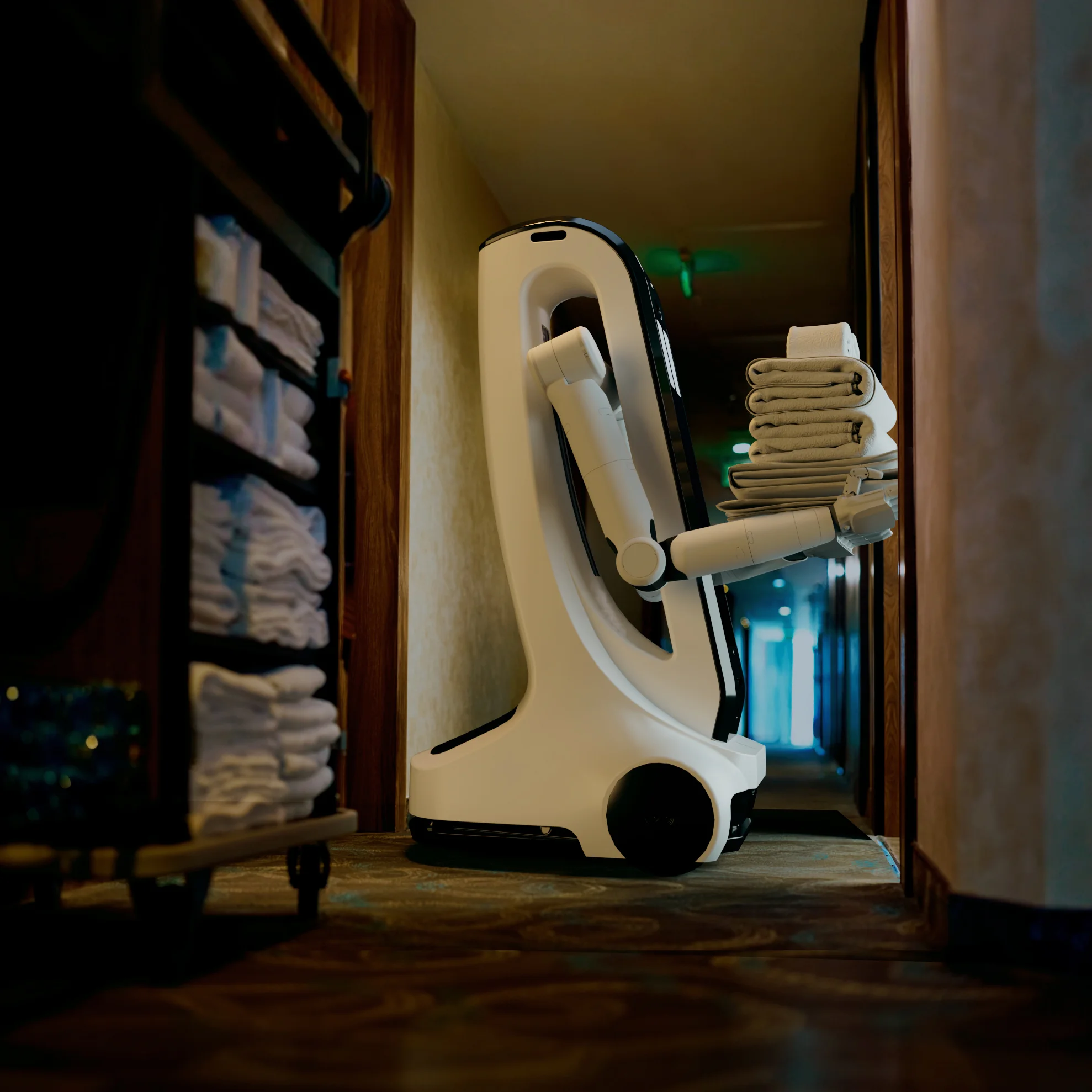
Planning instead of programming: how our robot breaks down tasks itself
Over the last few months we have brought the individual building blocks together: navigation, object detection, the management platform and the training-data flywheel. The result is an architecture that fundamentally simplifies how our robot is controlled.
Two levels of thinking
- The planner: A language and vision model understands the instruction and the environment and decides which steps are needed in which order.
- The skill library: Every skill, whether driving, grasping, placing or reporting, is tested on its own and can be combined freely.
The planner calls these skills directly. A new task usually just means a new combination of existing skills, not new code.
Openly connected
The robot can be controlled through a single interface: a web API, the command line, or the Model Context Protocol (MCP) directly from an AI agent. That makes it easy to integrate into a building's existing systems.
Tested on several platforms
In simulation, this architecture already runs on a humanoid robot and on a mobile manipulator. Next steps: more skills, more hotel and care scenarios, and the move from simulation into real test environments.